
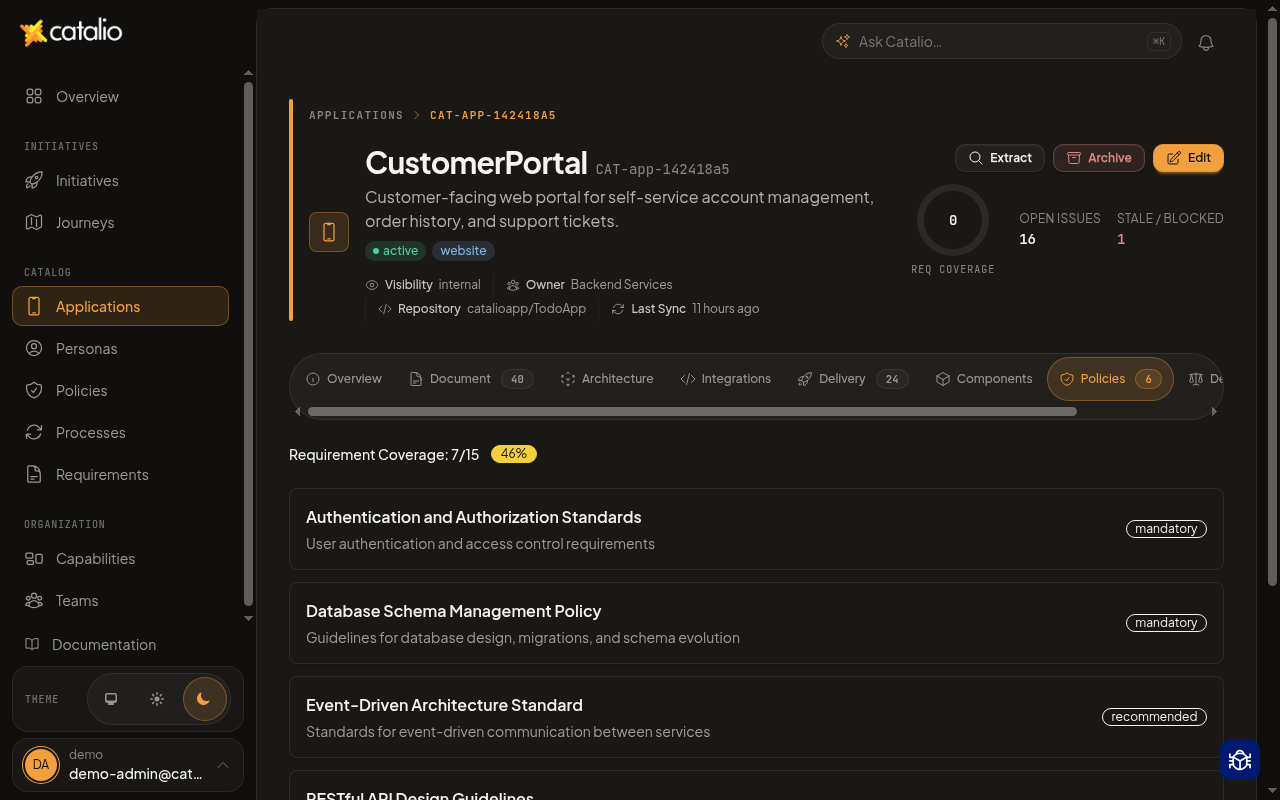
Find orphaned config
Surface automations and fields that no longer map to an approved business requirement.
Solutions · SaaS platform configuration
Custom fields, validation rules, and automations multiply until nobody knows why a config exists. Catalio links business requirements to platform configuration so change stops being archaeology.
Salesforce available today (Beta) · NetSuite on the roadmap

Config → requirement → approval
Admins change rules daily. A field edit in Salesforce can break three downstream workflows — and you find out when users complain. Wikis and “FINAL_v3.xlsx” don’t fix that.
Config tied to business requirements
Rationale for every rule & automation
Impact visible prior to deploy
Requirements that explicitly link to platform configuration — with owners, approvals, and validation history.
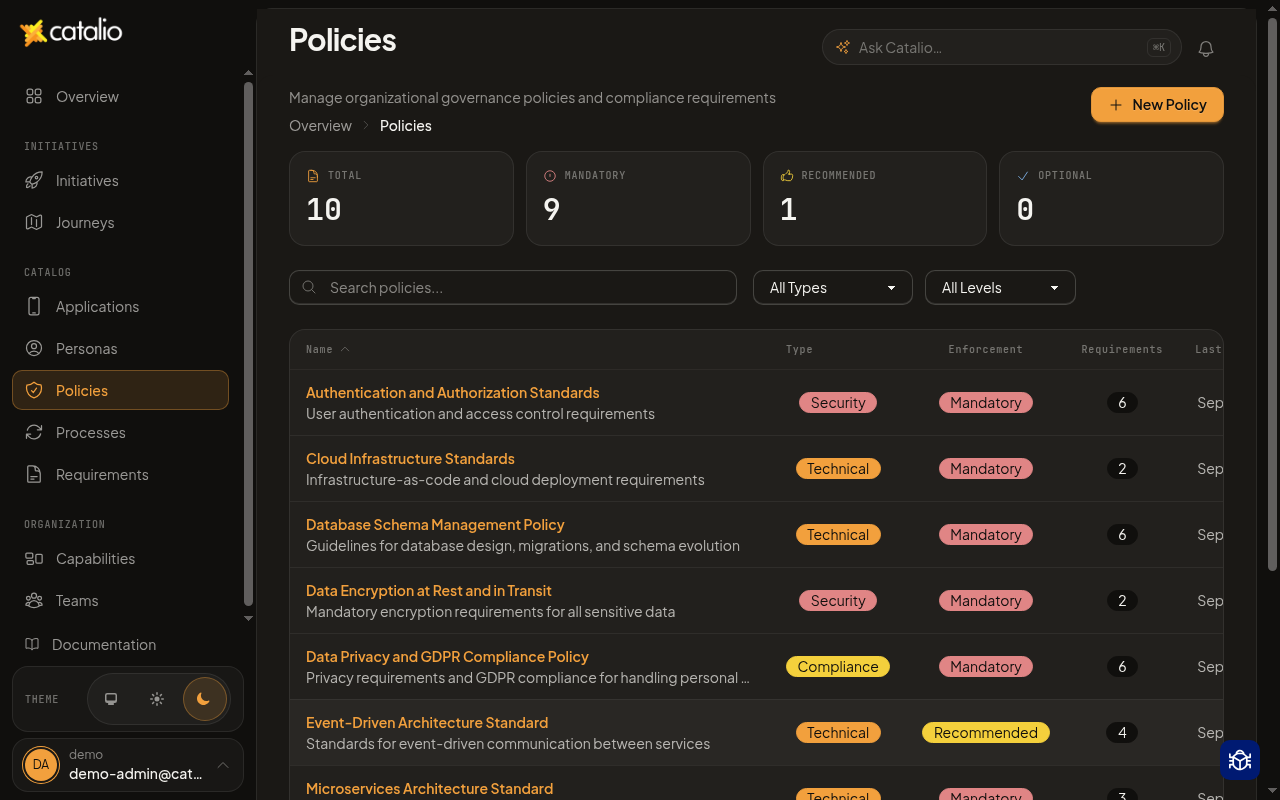
Surface automations and fields that no longer map to an approved business requirement.
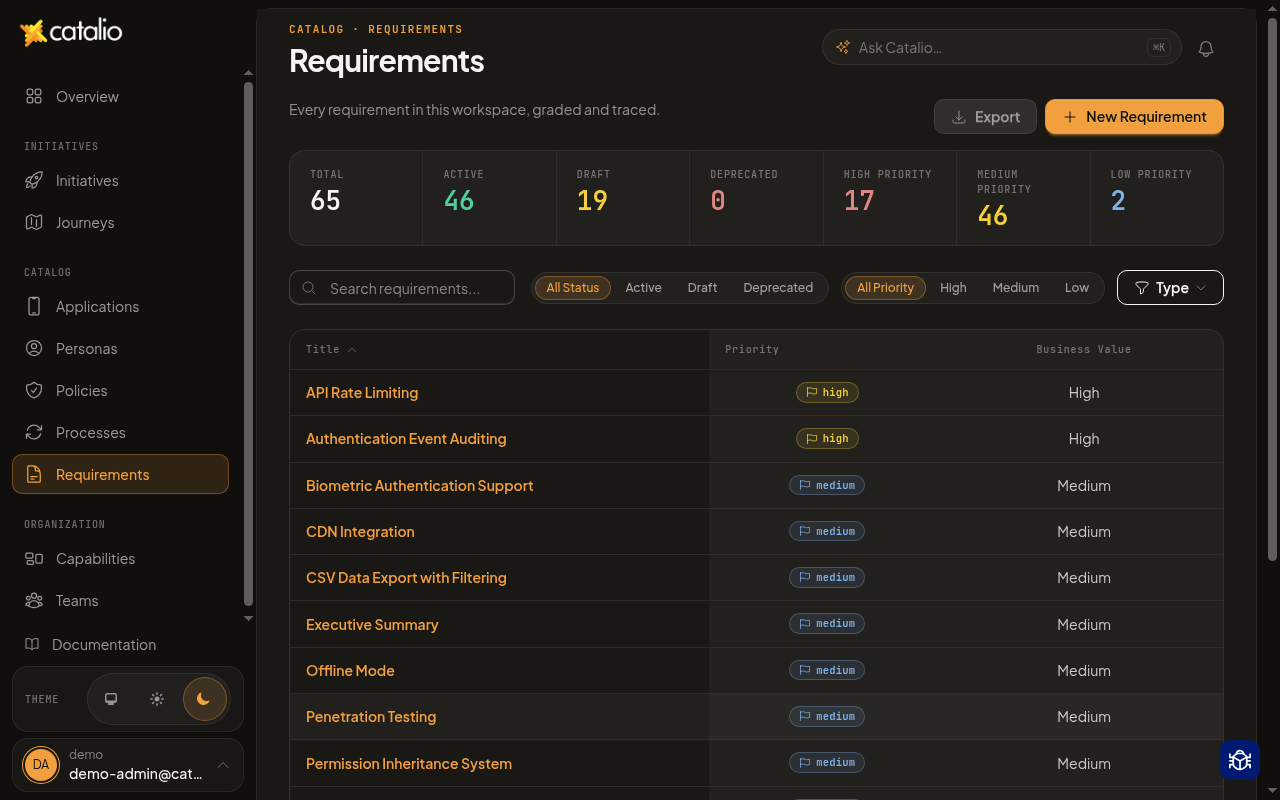
Pull Salesforce metadata into candidate requirements — then verify with your admins and process owners.

Stop relying on hero admins. Make every customization explainable, approvable, and durable.
Sync Salesforce configuration (Beta) into Catalio as structured candidates linked to objects and rules.
Attach business why, owner, and approval — so “what does this rule do?” has an answer.
Assess impact across related requirements before the next admin deploys a “quick fix.”
CRM, ERP, and the integration glue between them — one requirements discipline.

Validation rules, flows, and custom objects mapped back to process owners and compliance needs.

Use Catalio’s general requirements model today; native NetSuite integration is on the roadmap.
How SaaS configuration is documented today versus tying every rule back to business intent.
| Category | Traditional | Catalio |
|---|---|---|
| Documentation | Wikis and FINAL_v3 spreadsheets | Requirements linked to live configuration |
| Dependencies | Invisible until production breaks | Related requirements surface impact early |
| Approvals | Slack threads and tribal OK | Owner, rationale, and history on the record |
| Admin turnover | Knowledge walks out the door | Institutional memory stays in the map |
| Audit / compliance | Scramble to explain why a rule exists | Traceability from business need → config |
Advisory board
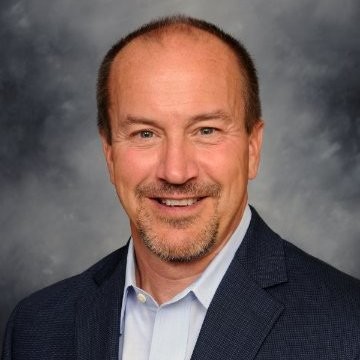
Wayne has 40 years helping food, retail, distribution, and consumer products companies transform their businesses worldwide. He most recently served as Executive Vice President and Chief Technology Officer at Sysco Corporation, the global leader in foodservice distribution, and was previously Chief Information Officer at SUPERVALU and Global CIO at Cadbury PLC, where he was based in the UK and led ERP and customer-facing programs across six continents. Wayne is currently an Independent Director at Armstrong World Industries (NYSE: AWI). He is a Boardroom Certified Qualified Technology Expert (QTE) and a 2017 inductee into the CIO Magazine Hall of Fame.
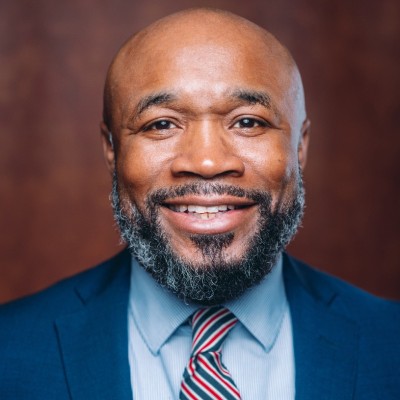
Jonathan has 25+ years building and scaling technology organizations across healthcare, financial services, energy, and SaaS. He founded and grew ForceIQ through its acquisition by Huron Consulting Group, and has served as CTO and strategic advisor to PE-backed and enterprise product companies at critical growth inflection points. His background spans platform modernization, engineering transformation, and responsible AI adoption, with a focus on how large organizations navigate complex technical change.
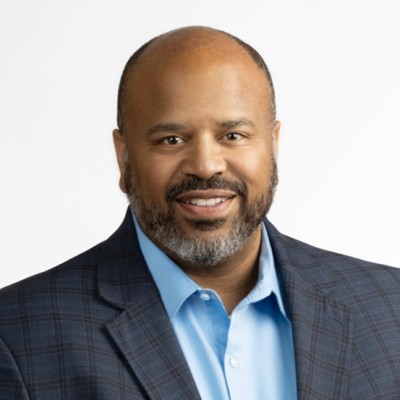
Wesley has 30+ years building and scaling global technology organizations and leading enterprise-scale digital transformation. He most recently served as CIO at Genesys and enterprise strategist at Amazon Web Services, with prior senior technology leadership roles at Sysco and Walmart, spanning retail, wholesale distribution, hyperscaler cloud, SaaS, and telecom. His work spans cloud and platform modernization, responsible AI/ML and data adoption, and post-M&A integration across global, matrixed environments. Wesley was named a 2023 Orbie Global CIO of the Year.

Every field and automation should answer: why, who, and what breaks if we change it.
FAQ
Salesforce integration is available today (Beta). NetSuite is on the roadmap. For other SaaS tools, use Catalio’s general requirements and traceability features as a documentation discipline.
The goal is faster safe change — extract and attribute once, then stop rediscovering intent every release train.
Yes — that’s the point. Link each rule to a business requirement with owner, rationale, and approval history.
Book a demo on one Salesforce org and connect config back to business intent.
Book a demoGet started
A working session on one of your systems: connect it, watch the extraction, and read the first requirements together. 30 minutes.
We can't find the internet
Attempting to reconnect
Something went wrong!
Attempting to reconnect